
Picture this: you're in the Q3 roadmap review. Sales has a deal worth real money that needs a custom integration. Support has a bug that's costing you renewals. Product has the format three large partners keep asking for. Meanwhile, another PM is lobbying for something that won't produce a dollar for six quarters...and even then can't tell you how much.
Obviously, you fund the first three (and you should), and so would any other leader with OKRs or a P&L.
However, if you systematically default to that type of decision making - prioritizing targets hit, customers served, roadmap delivered - you can have your best year ever while simultaneously making the company less differentiated, and destined for mediocrity.
The Core Paradox
When every decision passes a test requiring logical, sensible, and measurable justification, it stops testing strategy, and instead tests consensus.
You become locally prudent, and globally broke... not "broke" as in bankrupt; but "broke" as in nothing compounds.
You can execute your plan perfectly, where every expense is well justified, and find it's still not enough. That's the trap: the evidence that convinced you, would have convinced any competent team working in the same market. That's the hidden property of best practices: they're shared, and shared reasoning produces shared roadmaps, and shared results.
A series of disconnected good decisions eventually adds up to something everyone else would have built. So you never move toward a cogent and coherent thesis for how you win.
The Competence Trap
Strong, experienced operators get hired specifically for their operational excellence. The org then expects vision to emerge from execution, but it never does. Operational excellence doesn't generate vision; it optimizes whatever vision it's handed. So, if it's handed nothing, it optimizes the status quo.
The risk isn't failure. It's successful obscurity.
You ship, you hit targets, you grow...and nobody notices. Not because the work is bad, but because it never cohered into something that mattered beyond the quarter it was delivered in.
What Christensen Actually Explained
The Innovator's Dilemma gets (incorrectly) summarized as "big companies are slow and dumb," which is a startup-ecosystem reading of a book that says the opposite.
Christensen's incumbents aren't incompetent; they're disciplined. They serve their best customers, protect their margin structure, and decline the low-end business because the math says decline it. Every step is correct, but the sum of those steps is fatal.
That explanation depends on having a profit pool to defend, like Kodak in film, and disk drive makers in the high-end market. Their prudence had something to be prudent about.
But the version I'm describing here is different; there is no existing fortune to protect. Instead, here teams are entering hot markets with capital, talent, and executive air cover. However, in spite of all of those tailwinds they end up as also-rans without ever visibly failing. The core issue is that they optimize for presence in a category rather than owning one.
So, if The Disruptor's Paradox is about losing your edge, this is about never building one.
The Perpetual Reset
The machinery that produces this effect rolls as follows:
- Revenue arrives
- Urgency and measurability claim it first
- Individual initiatives win, but leverage never compounds
- New investment is deferred
- Next cycle resets
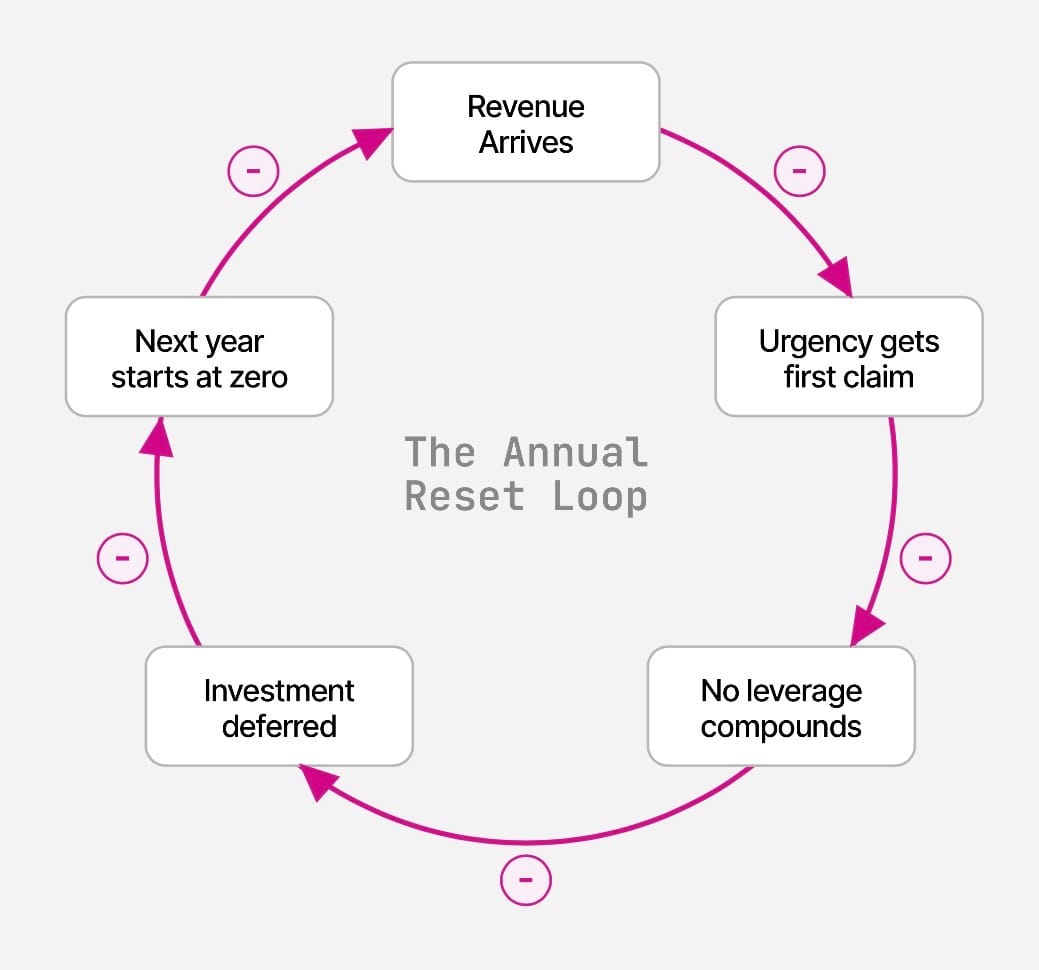
Urgent and measurable work will always have the cleanest justification. But, work that compounds never starts because urgency renews itself every ninety days while investment only pays out on a horizon longer than the next review cycle, so a patient bet looks wrong at every single checkpoint where someone is authorized to kill it.
The Streetlight Effect
KPIs are the justification machine; they're how each of those decisions won the room, and they're why the compounding bet never survives it. Using KPIs alone is like the old story of only looking under the street light for lost keys: because that's where the light is.
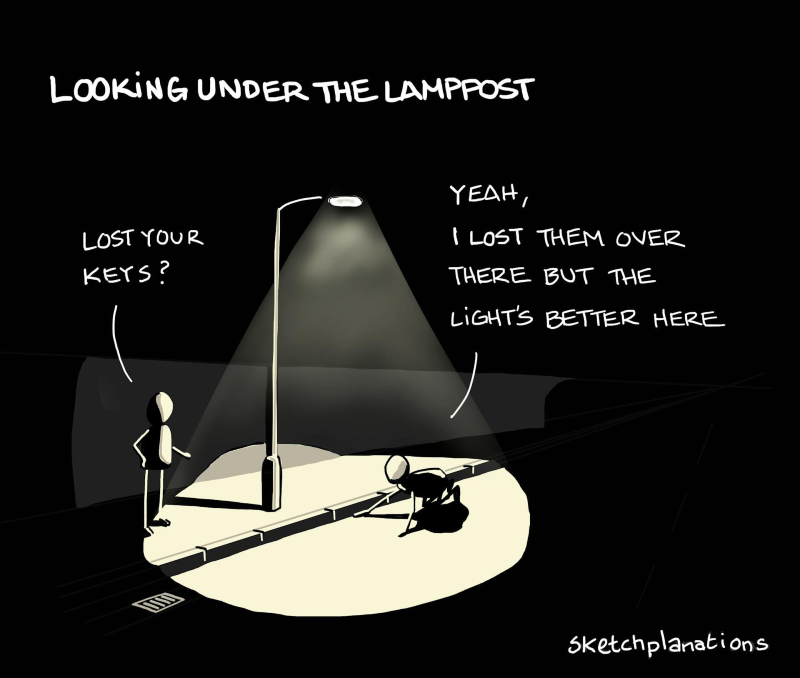
Measurement validates the present, while strategy is a bet on a different future. So, a plan to triple the market requires believing in customer behavior and capabilities that don't yet exist, and by definition there's no data for things that don't yet exist.
Meanwhile, the bottoms-up model only requires extrapolating what you can already see. The result is that while a measurement apparatus is supposed to be neutral, it instead carries a structural bias toward incrementalism, while masquerading as objectivity.
The Vision Litmus Test
Next time you're in that Q3 review, ask:
If we execute this roadmap to the letter, what becomes possible, or true?
If the answer comes back in KPIs, like "win share", "grow margin", or "improve NPS" that's not a vision, it's merely describing the state of the scoreboard.
A vision describes a state of the world, and it answers harder questions, like:
Why does a customer choose us. Why do we deserve to win? What's true about the market if we
The inversion is that we're no longer asking "is this justified", instead we're replacing it with "what does this leave behind"?
Leading vs Managing
Anyone can say no to bad ideas; that's management, and management works perfectly well inside the trap. Leadership means saying no to good ideas, with real revenue and defensible ROI, on incomplete information, against a dashboard telling you you're wrong.
It looks reckless from every seat in the room. That social pressure is what keeps the paradox alive: kill a defensible project to fund a speculative one and you look irresponsible to everyone who hasn't seen your reasoning. The quarterly review has no line item for "things we chose not to build so that something else could compound." It shows what you shipped and what you missed.
Breaking the cycle requires two moves: build enough leverage that this year's work survives into the next, then aim that leverage at the vision.
Building Leverage
A business resets to zero when it spends all its capacity on work that has to be justified, funded, and performed again next year. Three forms of leverage break that pattern:
Team: Raise the talent density and the judgment in the room. More capable people are only the start; you need a team that can say no to a good idea for a better one, then hire and coach the next generation to do the same.
Tech: Build proprietary capabilities you own: data, models, partners, or infrastructure that you establish once, and that improve with use. Each improvement expands what you can ship next.
Tools: Codify how your best operators work so the whole team can run at that level: agents, packages, price lists, workflows, and decision rules. Otherwise, the playbook walks out of the room with the person who invented it.
The capacity has to come from somewhere, which is why leverage requires a DO NOT BUILD. Bring the integrations, custom requests, and defensible roadmap items you will stop funding so this work can compound. The list will contain good ideas; bad ideas were never the problem.
Delivering on your Vision
With leverage in place, the second job is to aim it at the vision. Take that vision seriously enough to let it change how each team's work ladders up, what no longer makes sense, and how plans, priorities, and allocations change.
Then review the thesis against what you learned, rather than making it win a new ROI contest every quarter. Ask whether the evidence has weakened the claim about the world you're trying to create; if it has, change the claim or stop. If it hasn't, keep building.
If the vision doesn't change the roadmap, the headcount plan, or the budget, it's still a presentation.
Next quarter you'll be back in that room. The bug will still be costing renewals, the deal will still be real, and the patient bet will still lose any one-quarter comparison. This time, though, you'll know which work compounds, which work stops, and what all of it is supposed to make true.


