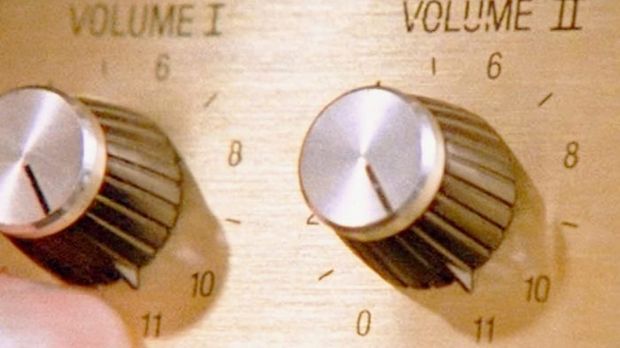
Ok, imagine all of your AI transformation dreams have come true: every workflow automated, every employee with teams of agents, cycle times have collapsed, and costs have fallen. You have turned the company's productivity dial all the way to 11, such that you've effectively replaced your company operations with a supercomputer in the corner of the room.
Now what?
Everything you've optimized is inward looking; you made yourselves faster, cheaper, leaner. However, looking outward, nothing has materially changed for the customer. Therefore the supercomputer is built to run yesterday's company faster. That's the gap.
The AI Transformation Pyramid
I recently did a literature review of major enterprise AI transformation frameworks.
What I noticed is that everyone agrees on the basics: foundations, productivity, process, but after that there is a divergence of opinions. I'll assert that you not only want to focus your AI transformation efforts on a more efficient company, but also a meaningfully better customer experience. So here's my version, which we can call the AI Transformation Pyramid.
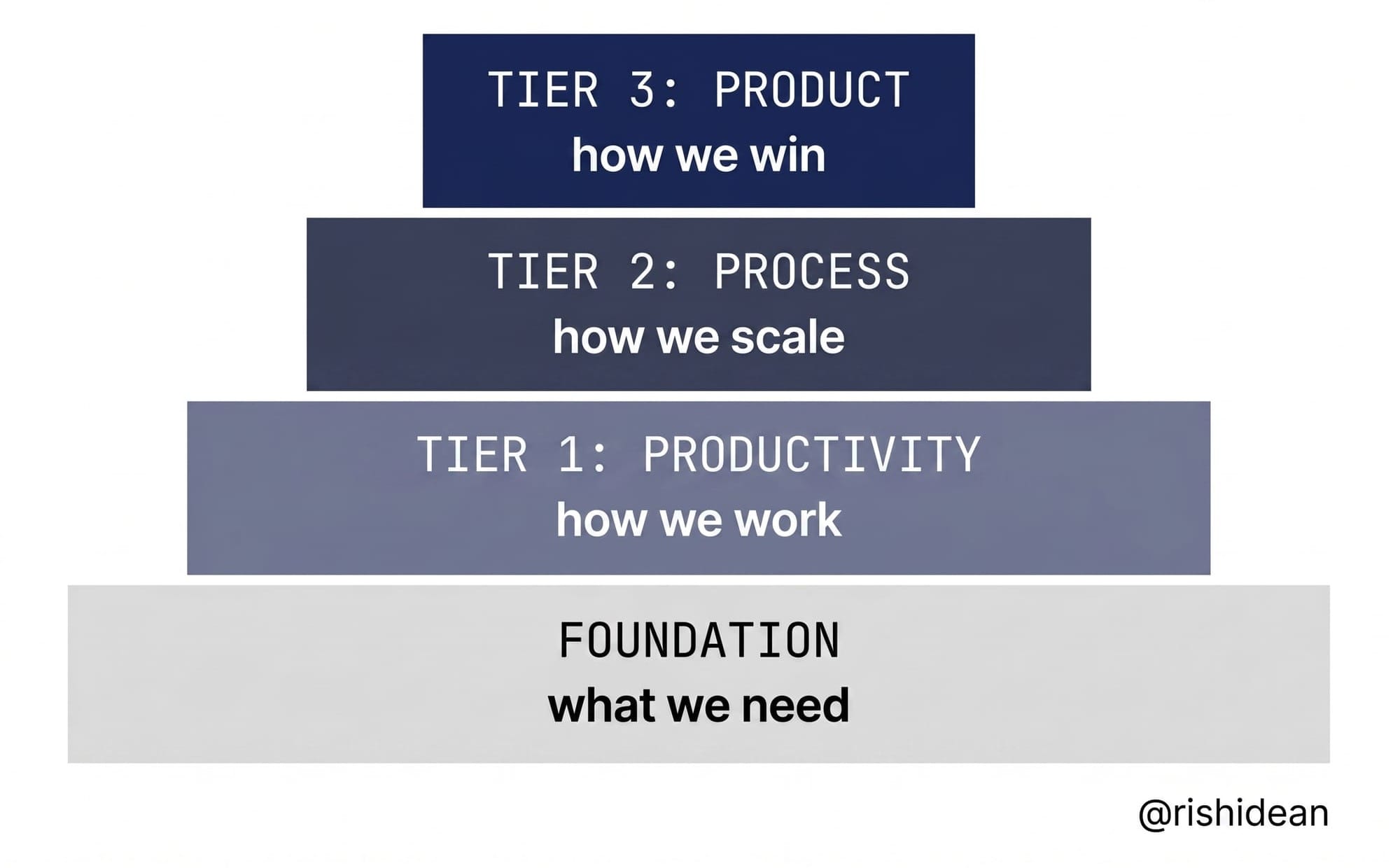
The Foundation - The Right to Play: tools, models, tokens, infrastructure, governance, security. Necessary, not strategic. Without it, nothing works, and with only it, nothing about you is different. You're now invited to the game.
Tier 1 - How we Work: AI helps people move faster inside the workflows you already run. Code autocomplete, agents, and as you move through the AI Adoption Continuum, you'll see real results, and feel a real morale boost; but it's also table stakes.
Tier 2 - How we Scale: This is where you are mastering the AI Adoption Continuum, so the work fundamentally changes. Agentic workflows start rewriting entire processes, with little or no human in the execution path. The gains here are no longer linear, but stepwise; your organization starts to change and scale because of it. However, it's still not the end of the story, since every one of your competitors is doing the exact same thing.
Tier 3 - How we Win: AI changes what the customer can do. New products, experiences, and business models. You're now doing things that weren't possible in the previous era, such that you can have a different relationship with the user, not just a faster version of the old one.
The AI Continuum explains how organizations climb the adoption curve, the AI Transformation Pyramid gives you a reason to climb it.
When the Efficiency Dial Goes to 11
These companies are not stupid, nor are they choosing the wrong strategy. They are choosing the obvious one, because Tiers 1 & 2 sit right in front of them. Somebody installs Claude Code, or Codex, and productivity climbs...materially. So it is a real win, but if you stop there it won't matter.
The hard part is that few are talking about, thinking about, or executing Tier 3. There are no playbooks, maturity models, or vendors selling "product reinvention."
Back to that dialed-up company, operations now flawless and nearly free (energy and tokens aside). For the customer, they may see faster processing, or some cost savings passed along (but probably not). Their burden is identical, they are doing the same job, and feeling the same friction. While the company's margins improve, the customer's world does not.
The Supercomputer Test
The honest test: if you removed AI from your business in three years, what would break?
If the answer is "we would be a little slower at the same things," then that's just AI Adoption, not AI Transformation. Your dream state is still a very fast supercomputer doing the same old work.
If the answer is "entire products vanish, whole customer segments become unreachable, the cost structure collapses," that is transformation.
Most companies fail this test today, not because they are behind, but because they mistook the supercomputer for the finish line.
The three forces tying you to the supercomputer model:
The metrics flatter you. Tiers 1 & 2 can show gorgeous internal numbers, for every metric from cycle times down to production velocity up. While all of that looks good in the boardroom, none of it reaches the customer. So you feel like you're winning because you are reading the wrong scoreboard.
The work is finite and safe. Rolling out a tool, is a known project. You scope it, staff it, ship it, and exchange high fives. Reinventing your product is open-ended, scary, and political... so guess which one gets funded?
The floor moves. Once every peer has AI-assisted operations, you get no credit for having it. You only avoid falling behind. It is the Incumbent's Dilemma in a new outfit. The efficiency gains that feel like progress are just the new baseline. So the supercomputer is really keeping you from drowning, not helping you swim.
"We deployed AI across 12 workflows and saved $40M in operating costs."
Cool, but here's the kicker: so did every company you compete with. And the insurgents you have not heard of yet? They have been AI-native since day one, and they are coming after you with a totally reimagined customer experience while you have a faster back office.
Where the Race Is Actually Run
When efficiency becomes table stakes, the only thing left to compete on is what AI does for the customer.
Tier 3 is not an extension of the same roadmap. It is a new roadmap entirely, optimizing for a different outcome.
Tiers 1 & 2 ask: how do we do what we already do, faster and cheaper? Tier 3 asks: what can we do that we could not do before?
Take travel. Tier 1 helps an agent answer your question faster. Tier 2 rebooks your canceled flight on its own. Tier 3 means you never manage the disruption at all. The system sees the storm coming, knows your calendar, knows you hate red-eyes, rebooks the trip, moves the hotel, and tells you what it changed while you slept. That is a fundamentally different product than a chatbot.
Those two questions do not even live in the same building. The first belongs to your COO and CTO. The second belongs to your CEO and CPO, without the latter's commitment, Tier 3 does not happen.
This is where the AI Continuum runs out of road, since it's meant to tell you the level of mastery your organization exhibits. But the Supercomputer Test asks a different question: what did all the movement create and for whom?
What Tier 3 Looks Like
Surface destruction. The product stops needing the menus, screens, and flows you shipped for a decade. The user just says what they want. Whoever gets there first owns category-defining real estate. This is not a slicker version of the same product. It is a different product entirely.
New revenue surfaces. Businesses that never existed because the unit economics did not work. Long-tail commerce. Hyper-personalized media. Markets too small to serve by hand and too big to ignore once an agent serves them.
Customer-facing autonomy. Let users delegate, not just type. The shift from "tools that help me work" to "agents that work for me." Most enterprises have not even started.
You will know you have crossed into Tier 3 when the product team gets uncomfortable, the org chart gets strained, and the v1 builders get territorial. That discomfort is the tell that you're upending the existing processes & products.
The supercomputer in the corner is impressive, but it's invisible to the people who pay you.
If your customers can't feel it in their own lives, you haven't transformed. You have just built a very expensive way to run yesterday's company.


