
I researched various Enterprise AI Transformation frameworks, to see if there was an industry consensus. The good news is that they agree at the early stage, but diverge later, when things get more complicated.
In my Supercomputer post, I talk about how the industry is viewing AI transformation more as a Productivity & Process enhancement, than a Customer one. Consider this an appendix to that post, where I perform a "literature review", based on what I could find and analyze. Admittedly it's by no means exhaustive, or overly academic, but think of it as a distillation of the main ideas.
I'll start by going through five frameworks, and just calling "balls & strikes"; meaning I'll distill the main ideas as the authors wrote them. At the end I'll bring them all together to compare, but if you want my analysis, and overall framework, you can find that in the main post.
Note
The only place I'll put my thumb on the scale is to ask you to keep one question in mind as you read each one: where does the customer fit in? I think it's pretty important (ok, most important), and you'll see that some factor it in explicitly, while others do not.
McKinsey, Three Horizons of Growth (1999)
This is the granddaddy framework, published before the AI era, and really even before the Cloud era. However, it's a seminal piece that lays the foundation for what comes after.
McKinsey sorts a company's ambitions into three "horizons":
* Horizon 1 is defend and extend the core business you already run
* Horizon 2 is build the emerging businesses next to it
* Horizon 3 is create the genuinely new ones, the seeds of what you become
McKinsey's own caution with it is that organizations over-invest in Horizon 1 and starve Horizon 3, because Horizon 1 is legible and fundable and Horizon 3 is neither. An interesting note is that you could argue the customer fits in at the end state; however, it's framed as new businesses and the company's own growth, not the customer's experience specifically.
OpenAI, The Five AI Value Models (2026)
This is the most current, and most granular, map I found. It details five phases, meant to be addressed in sequence:
* Workforce Empowerment
* AI-Native Distribution
* Expert Capability
* Systems and Dependency Management
* Process Re-engineering with agents
OpenAI's framing is that each phase lays the groundwork for the next, so it's about following the sequence. Notably, their most transformative ends at Process Re-engineering. That is, agents orchestrating end-to-end internal workflows.
And the single model that faces the customer, AI-Native Distribution (how people discover, evaluate, and choose you), is sequenced at position two, an early capture rather than the summit.
MIT CISR, The AI Maturity Model (2025)
This is from MIT's Center for Information Systems Research. In it they define four stages:
* Experiment and Prepare
* Build Pilots and Capabilities
* Industrialize
* Future-Ready
The main finding in the report is that companies in the bottom two stages financially underperform their industry peers; whereas, companies in the top two outperform them.
The Future-Ready stage is defined by new business models, reshaped customer experience, and developed ecosystems. So here they explicitly call out customer experience.
Michael Alf, The Three Levels of AI Utilization (2025)
This is more of a practitioner framework, which defines three levels:
* Personal Productivity (tool-centric individual gains)
* Process Improvement (reimagined workflows)
* Innovation (new business models, products, and services that were not possible before)
Alf grounds his model in history, such as when electricity replaced steam, factories first swapped the power source and kept the old floor plan, and it took decades before anyone redesigned operations around what electricity could actually do. The early internet just digitized the paper catalog. The reinvention came later, from companies built around the new thing rather than companies bolting it onto the old thing. This is the classic skeuomorphism take on new tech. He does call out the customer at the innovation level of the framework.
EY, The Sameness Trap (2026)
Unlike the others, EY's piece isn't a maturity ladder; it doesn't describe tiers at all. It's a cross-cutting warning that applies the whole way up the climb.
EY's claim is that organizations that over-rely on AI without human taste converge on identical ideas, because the model optimizes toward the average. They describe separate teams, each convinced it had invented something fresh, collectively producing the same product. Their mechanic: the most confident-sounding voice in the room speaks first, everyone else stops originating and starts reacting, and AI is now that voice in every room. Their prescription is to make the human form a hypothesis before consulting the model.
Here, the customer experience is positioned as an "escape hatch" out of sameness, by providing tangible differentiation. However, it's pretty vague on that point.
Where they agree, and where they don't
Let me break these five down, and show where they both converge and diverge. Well, I diagrammed it first:
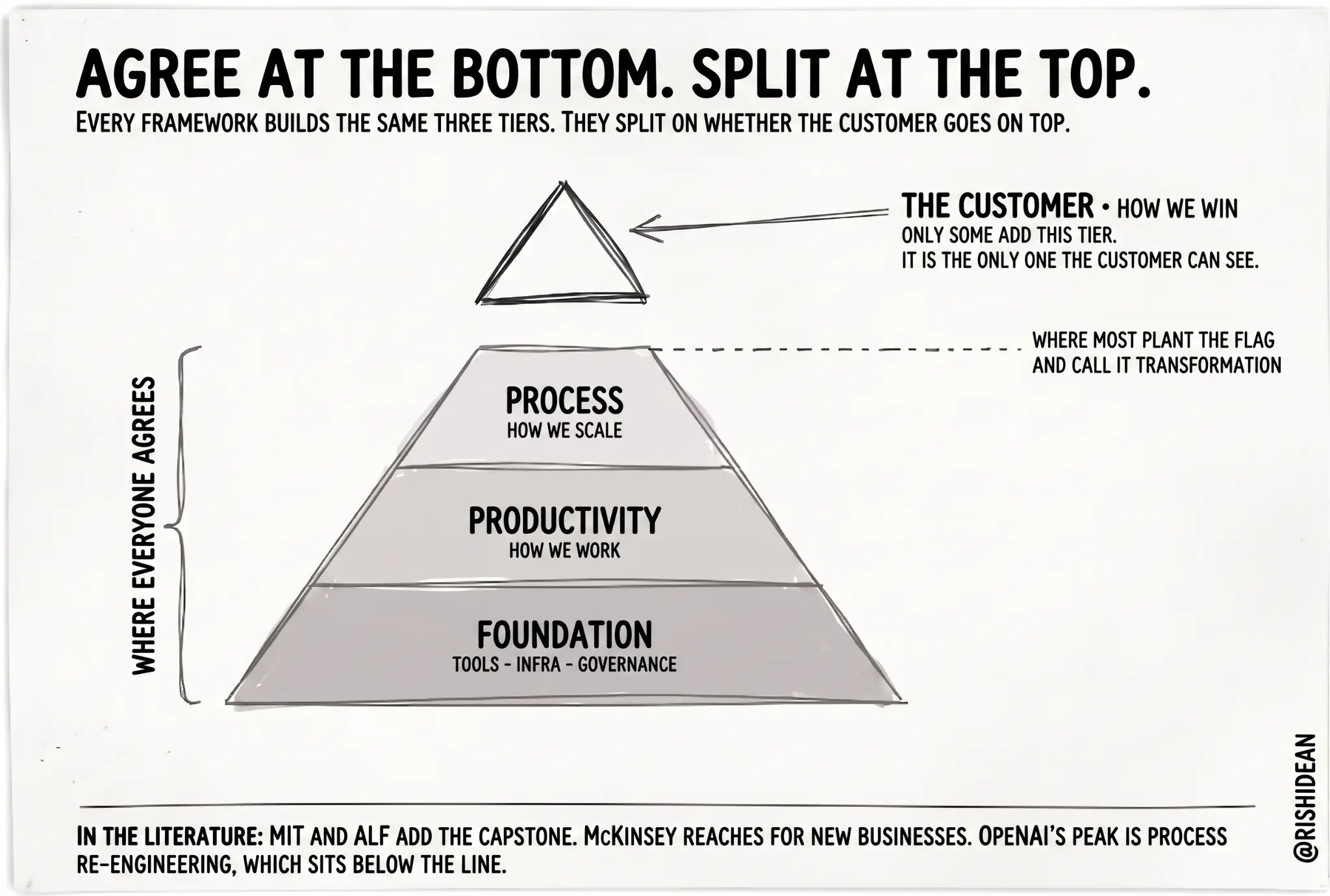
Everyone agrees how it looks early on
So here's where they converge:
* Everyone agrees getting the foundations right is critical (but not sufficient)
* Everyone agrees AI should make you efficient
* Everyone agrees you should scale that efficiency through revamping your processes
(Strictly, that's four of the five. EY is the holdout, but only because it isn't a ladder; it doesn't dispute the base, it just doesn't speak to it.)
This whole base is really an adoption-maturity story, and how far you've actually climbed it. Similar to my own framework I shared in the AI Adoption Continuum. That's the settled, boring, non-negotiable part of the consensus, and also the exact thing every one of your competitors is doing right now.
The later stages is where they diverge
Here's how each of them sees the end state:
* McKinsey's summit is new businesses, to drive the company's growth
* OpenAI surprisingly doesn't talk about the customer at all; its peak stops at internal process re-engineering
* MIT names the customer's experience at the summit, in plain language, and backs it with a P&L finding
* Alf puts new products and services as the goal
* EY says the only exit from sameness is differentiation the customer can feel
Bottom Line
The consensus is real: everyone agrees on how to start, and diverge in explaining what the end state is. Most gesture at new business models; only some (the camp I'm in) say the thing that actually counts is the customer's experience. And the most current framework of the bunch doesn't point at the customer at all.
So where you go next depends on what you need:
* For the internal adoption journey, how your org climbs from tools to redesigned work, that's the AI Adoption Continuum.
* For the strategic question of what's it all for, and can the customer actually feel it?, that's the Supercomputer post.
That second question is the whole point. Turn the productivity dial to 11, replace the company with a supercomputer in the corner of the room, and you still have to ask: did anything actually get better for the people who pay you?
References
[1] McKinsey & Company. "Enduring Ideas: The three horizons of growth." link
[2] OpenAI. "The five AI value models driving business reinvention." March 2026. link
[3] MIT Sloan. "What's your company's AI maturity level?" February 2025. link
[4] Michael Alf. "The Three Levels of AI Utilization: A Framework for Transformation." LinkedIn, July 2025. link
[5] Ernst & Young. "The sameness trap: how AI can erase your edge." April 2026. link


