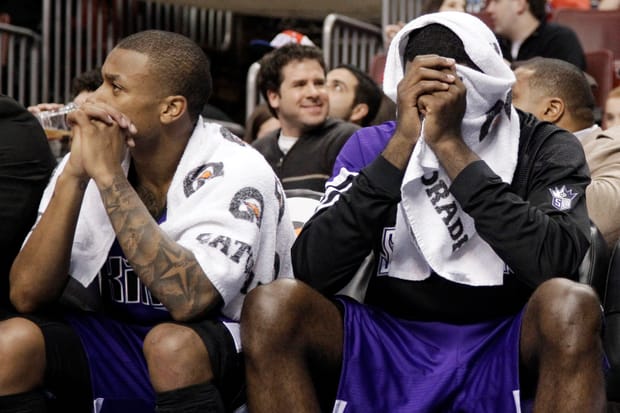
While the Sacramento Kings owner, Vivek Ranadivé is undoubtedly a brilliant business man, his recent proposal to play 4 on 5 defense is flawed, and here's why.
Data can lead you astray
Vivek Ranadivé (Founder / CEO of TIBCO) has an impressive resume, and has recently spent his time analyzing 30 gigs of basketball data to help his team:
Using TIBCO’s technology, Ranadive has applied the same big data-approach to the Kings’ player management. So instead of just drilling down box scores and regular stats, the Kings collect in-game data from six different overhead cameras, and analyze everything from player combination and spacing to shot clock usage and shot selection.
Unfortunately, one of his conclusions is to play 4-on-5 defense, leaving one player to "cherry-pick". Not sure what software he's been using, but any middle-school math, will tell you that's a bad idea.
Doing the (simple) math to debunk the 4 on 5 theory
The basic premise behind Ranadivé's theory is that missed shots by the opponent will lead to uncontested shots by the Kings. What he fails to account for is that the opponents will perform better against fewer defenders, and that getting defensive rebounds, and making outlet passes, also need to be accounted for.
1) The offense is 20% more effective
In playing 4 on 5, you effectively have 0.8 of a defender per every offensive player, which we can assume gives the offense a 20% boost (1/0.8).
Looking at stats from the 2013 - 2014 season, the average NBA field goal % is .454, while from behind the 3-point line it's .360. Therefore the adjusted field goal % becomes .545 and .432 respectively.
Then, weighting these percentages on the stat that there are approximately 4 2-point shots taken for every 1 3-pointer, we get an overall probability of .522 that the average shot is made. In turn, this yields a value of 1.13 as the expected points per shot attempt.
2) The defense has to get the rebound, throw an outlet, and then score
For the Kings to score, you must assume that their opponent misses AND the Kings get the defensive rebound AND make an outlet pass AND make the resulting shot.
So, if there is a .522 chance of a made shot, that gives us a .478 for a missed shot.
Then, the baseline offensive rebound % in the NBA is .255, but again we have to adjust that by 20% to account for there only being 4 defenders, to give .306, or a defensive rebound % of .694.
If we then assume that the probability of making a successful length of the court pass to the "cherry-picker" is 80%, and then let's give the chance of the resulting shot attempt, given a successful outlet, of 99%.
Your opponent will outscore you by more than double
Multiplying out all of those probabilities of each event occurring give us a value of .263, or an expected value of .52 points per defensive miss; while the offense is expected to make 1.13 per attempt.
Of course this doesn't account for lots of things, like defensive turnovers (harder with 4 guys), or other anomalies, but some quick back-of-the-envelope math can tell you that the NBA isn't like coaching his daughter's basketball team. That said, if he wants to try his theory out when playing my Raptors, then be my guest.
Unlike baseball, basketball has challenges that make some analytics unreliable. That said, if Ranadivé serious about this stuff, perhaps attending next year's MIT Sloan Sports Analytics Conference, should be in his future.


